BLAST ROOM
MANUFACTURER.
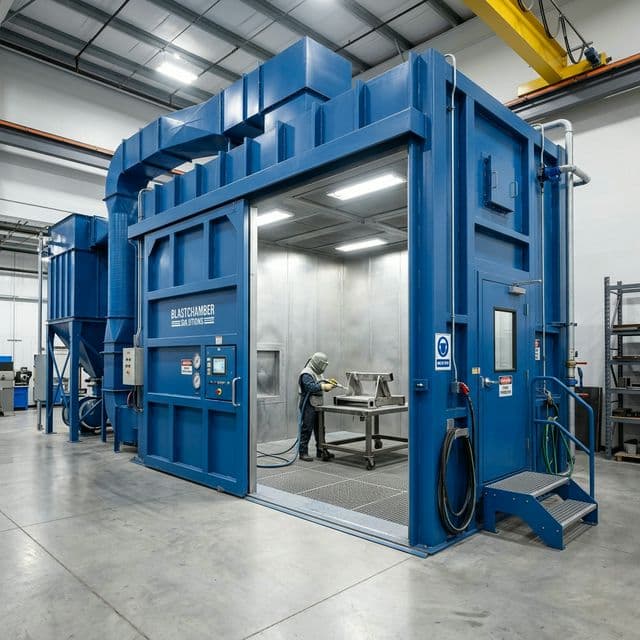
Metaflux Spray Solutions manufactures walk-in blast rooms in Pimpri-Chinchwad, Pune, for grit blasting large steel fabrications, structures and castings to SA 2.5 or SA 3 before coating.
Each room includes a full abrasive recovery floor, bucket elevator, airwash separator and pulse jet dust collector, and is built around the largest component the customer needs to blast — from a 3 x 3 x 4 metre booth to a 20 metre structural bay.
Control
PLC Blast CycleFiltration
99.9% at 1 MicronRecovery
Up To 95% MediaCustom
Built To ComponentBLAST ROOM MACHINES.
Three standard blasting machine layouts cover most grit blasting duties. Tell us the heaviest part, the dirtiest part and the parts per shift, and we will tell you which one fits.
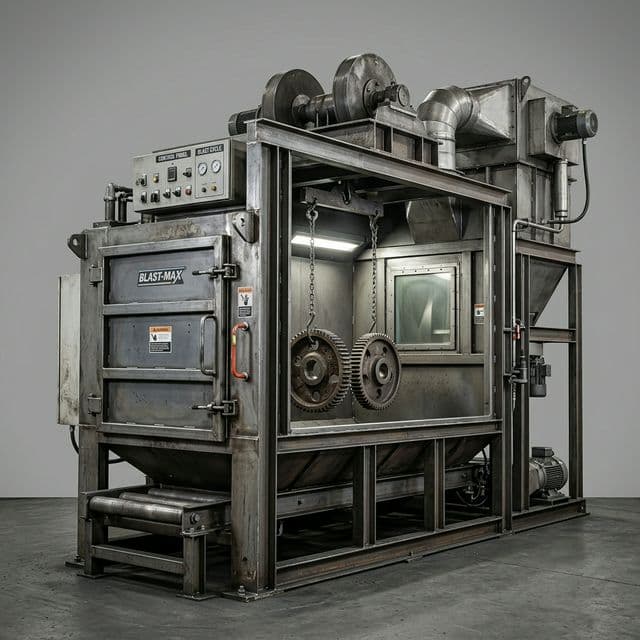
Spinner Hanger Machine
"Synchronous and multi-tasking modes engineered for complex workpiece geometry, hung on an overhead rail and blasted from every angle in one cycle."
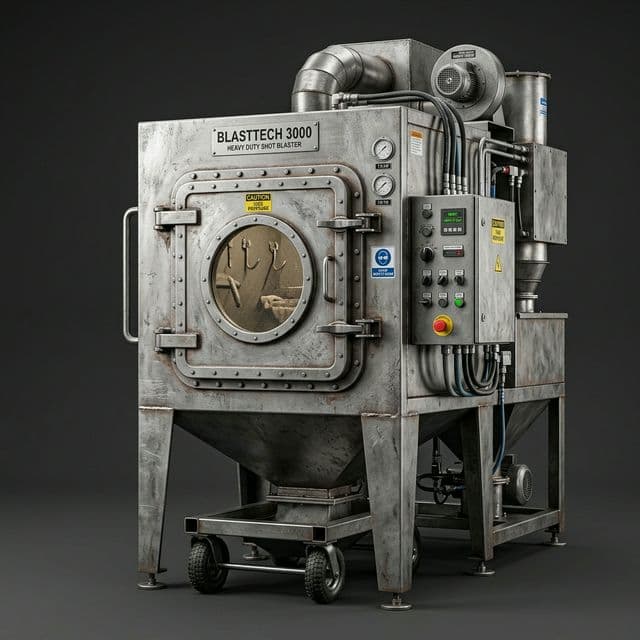
Swing Table Machine
"Suited for heavy-duty symmetrical components. The rotating table gives 360-degree coverage and strips mill scale in a single pass."
Tumblast Machine
"The mass-cleaning workhorse for castings, forgings and fasteners. A continuous rubber belt tumble action exposes every surface to the abrasive stream."
TYPICAL SPECIFICATIONS.
The numbers below cover the standard Metaflux grit blasting room build. Rooms are engineered per order, so send us the component envelope and shift target and we will size the wheels, the compressor and the dust collector against it.
| Parameter | Typical Range |
|---|---|
| Room internal size (W x H x L) | 3 x 3 x 4 m up to 8 x 6 x 20 m, built to your component envelope |
| Blast wheel / turbine rating | 5.5 kW to 22 kW per wheel, 1 to 8 wheels depending on throughput |
| Abrasive working charge | 300 kg to 2,000 kg of steel shot, chilled iron grit or aluminium oxide |
| Abrasive recovery | Up to 95% via screw conveyor, bucket elevator and airwash separator |
| Dust collector airflow | 2,000 to 12,000 CFM, pulse jet cartridge or shaker bag house |
| Filtration efficiency | 99.9% down to 1 micron on cartridge media |
| Compressed air requirement | 200 to 600 CFM at 6 to 7 bar for nozzle blasting |
| Nozzle bore | 6 mm to 12 mm long venturi, tungsten or boron carbide |
| Achievable surface finish | SA 2.5 to SA 3 (ISO 8501-1), profile 40 to 100 microns Rz |
| Operator protection | Air fed helmet, breathing air filter, interlocked door and lighting |
Indicative ranges across the standard build. Exact specifications vary by configuration and are confirmed on the approved general arrangement drawing for your order.
Frequently Asked Questions.
Direct answers on blast room sizing, abrasive recovery, dust extraction and the surface profile a coating needs.
What is a blast room?
A blast room is a walk-in enclosure in which an operator blasts large components by hand with a nozzle, while a recovery floor, elevator and separator collect and re-screen the abrasive for reuse. It is the standard solution for components too large for a cabinet or a tumblast machine — structural steel, tanks, railway bogies, castings and fabricated weldments. Metaflux Spray Solutions builds blast rooms in Pimpri-Chinchwad, Pune, from a 3 x 3 x 4 metre booth up to an 8 x 6 x 20 metre structural bay, sized to the customer's largest component.
What surface profile is required for a metallizing coating to bond?
ISO 2063 requires blast cleaning to Sa 3 with a sharp angular anchor profile of roughly 60 to 100 microns before zinc or aluminium metallizing, and the coating must be sprayed before any rust bloom forms — hours, not days. Metallizing bonds mechanically, so the profile is what holds the coating on; a smooth or peened surface gives adhesion failure regardless of how well the spray gun is set up. Angular chilled iron grit or aluminium oxide produces that profile, while rounded steel shot does not. This is why the blast room and the spray equipment should be specified together rather than separately.
How much abrasive does a blast room recover?
A blast room with a full mechanical recovery floor typically returns up to 95% of the abrasive to the hopper for reuse. Spent grit falls through floor gratings onto screw conveyors, is lifted by a bucket elevator and passes through an airwash separator that removes fines, dust and broken particles before the usable media drops back into the storage hopper. That recovery rate is what keeps abrasive consumption per square metre economic on large structures.
What size dust collector does a blast room need?
Blast room dust collectors are typically sized between 2,000 and 12,000 CFM, matched to the room volume and the number of nozzles working at once. Metaflux supplies pulse-jet cartridge units, which clean their own filters with compressed air pulses and hold suction steady through a full shift, and shaker bag-house units for intermittent duty at lower capital cost. Cartridge media filters to 99.9% at 1 micron. Under-sizing the collector is the most common cause of poor visibility inside a blast room and of dust escaping into the shop.
What compressed air supply does a blast room need?
A blast room typically needs 200 to 600 CFM at 6 to 7 bar for nozzle blasting, depending on the nozzle bore and the number of operators. A 6 mm bore draws around 90 CFM and a 12 mm bore around 400 CFM at 7 bar. The air must be dried and filtered, and the operator's breathing air line needs its own filter, because the air-fed helmet is supplied from the same compressed air system.
DUST COLLECTORS.
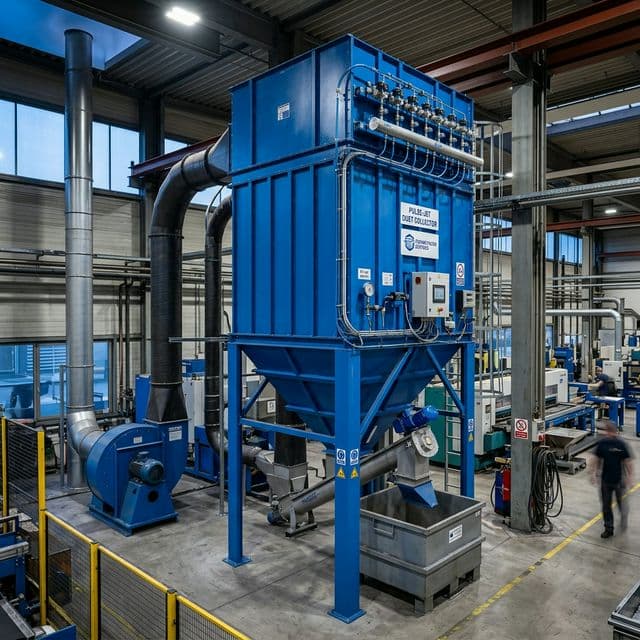
Pulse Jet Dust Collector
Cartridge filtration with automatic compressed-air pulse cleaning, so suction stays constant through a full shift of grit blasting.
Shaker Type Unit
Mechanical bag-shaking system for intermittent blasting duty, with a lower capital cost and no compressed air draw for filter cleaning.