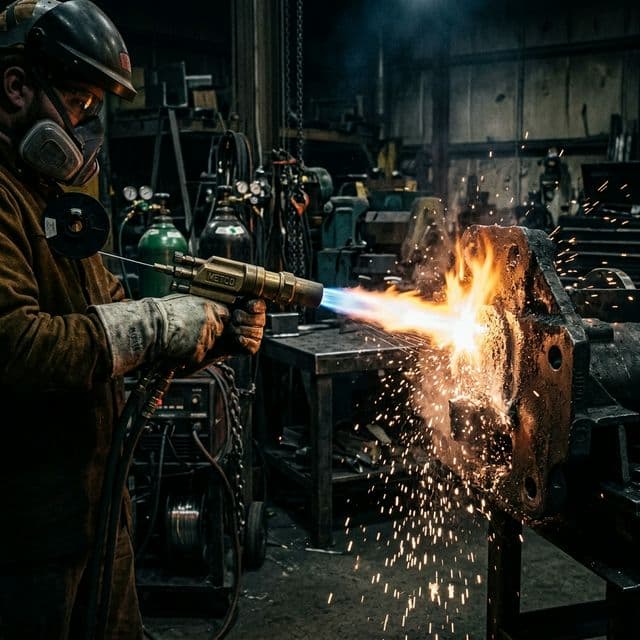
POWDER FLAME SPRAY GUN
FOR HARDFACING.
Metaflux Spray Solutions manufactures powder flame spray guns in Pimpri-Chinchwad, Pune, India, for applying self-fluxing nickel, chrome and cobalt hardfacing alloys to worn shafts, rolls and industrial wear surfaces.
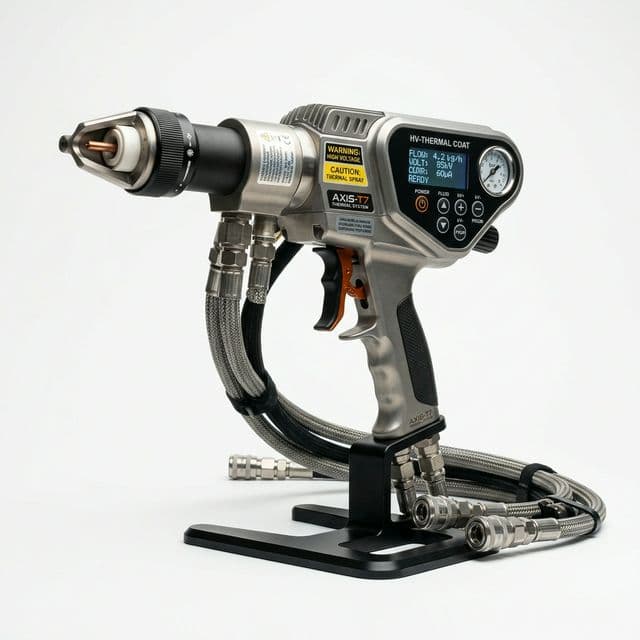
Powder Combustion Gun
Powder falls from a gun-mounted hopper into an oxy-acetylene flame and is deposited on the workpiece. Sprayed on its own the coating is porous and machinable; fused afterwards at 1,040 – 1,100 °C it becomes a fully dense, metallurgically bonded hardfacing layer up to 62 HRC.
TYPICAL
SPECIFICATIONS.
Typical operating data for the powder flame spray gun and its gun-mounted hopper. Exact specifications vary by configuration — request a datasheet for the model you are evaluating.
| Parameter | Typical Range |
|---|---|
| Powder Types | Ni-Cr-B-Si self-fluxing, NiAl bond coat, Bronze, Copper, Molybdenum, Alumina, Chrome Oxide |
| Powder Particle Size | 45 – 106 microns |
| Hopper Capacity | 1 – 5 litre (gun-mounted) |
| Fuel Gas | Acetylene (LPG on selected models) |
| Oxygen Consumption | 1.5 – 2.5 m³/hr |
| Fuel Gas Consumption | 0.6 – 1.2 m³/hr |
| Spray Rate — Metallic Powder | 2 – 6 kg/hr |
| Spray Rate — Ceramic Powder | 1 – 3 kg/hr |
| Spray Distance | 100 – 200 mm |
| Coating Thickness Per Pass | 100 – 300 microns |
| As-Sprayed Hardness | 20 – 62 HRC, depending on alloy |
| Fusing Temperature (Spray and Fuse) | 1,040 – 1,100 °C |
| Gun Weight | 1.0 – 2.5 kg |
FREQUENTLY ASKED
QUESTIONS.
The questions maintenance and reconditioning shops ask most often about powder flame spray and spray-and-fuse hardfacing.
What is spray and fuse?
Spray and fuse is a two-step process in which a self-fluxing nickel or cobalt alloy powder is flame sprayed onto the component and then heated to 1,040 to 1,100 °C so the deposit melts and fuses to the base metal. The fused layer is fully dense and metallurgically bonded rather than mechanically bonded, which is why it survives impact and heavy point loading that an as-sprayed coating would not.
Which powders does a powder flame spray gun use?
A Metaflux powder flame spray gun runs Ni-Cr-B-Si self-fluxing alloys, NiAl bond coat, bronze, copper, molybdenum, alumina and chrome oxide powders, normally sized 45 to 106 microns. Powder falls from a gun-mounted hopper of 1 to 5 litres into an oxy-acetylene flame and is carried onto the workpiece.
How hard is a powder flame sprayed coating?
As-sprayed and fused powder flame coatings typically measure 20 to 62 HRC depending on the alloy chosen. Softer bronze and NiAl grades sit at the low end and are used for bond coats and bearing surfaces; high-chromium, high-boron Ni-Cr-B-Si grades sit at the top end and are used for abrasive wear on rolls and screws.
Can a powder flame sprayed coating be machined?
As-sprayed, the coating is porous and can be turned or machined with carbide tooling, which makes powder flame spray convenient for restoring worn shafts and bearing seats to size. Once fused, the layer is far harder and is finished by grinding rather than by turning.
What is powder flame spray used for?
Powder flame spray is used for hardfacing and dimensional restoration — rebuilding worn journals, seal areas and bearing seats, applying nickel and cobalt hardfacing to sugar mill and steel plant rolls, and laying down fused Ni-Cr-B-Si layers where a metallurgical bond is required. Metaflux Spray Solutions manufactures the guns in Pimpri-Chinchwad, Pune.
How much does a powder flame spray gun cost in India?
Metaflux Spray Solutions quotes powder flame spray gun prices on request, because the price depends on the gun model, hopper size and the gas control and spares package supplied with it. Send the powder type, component size and expected duty through the enquiry form on this page for a written quotation from Pune.
Powder Flame Spray Applications
and Hardfacing Alloys.
Shaft Rebuilding
Restoring worn journals, seal areas and bearing seats to size.
Wear Rolls
Nickel and cobalt hardfacing on sugar mill and steel plant rolls.
Spray and Fuse
Fused Ni-Cr-B-Si layers with a metallurgical bond to the substrate.