SAND
BLASTING
MACHINE.
Metaflux Spray Solutions manufactures sand blasting and grit blasting machines in Pimpri-Chinchwad, Pune, for cleaning, deburring and profiling metal components with compressed air and abrasive media before coating.
Pressure and suction feed cabinets run garnet, aluminium oxide, glass bead or chilled iron grit at a regulated 2 to 7 bar at the nozzle, with cyclone media reclaim and cartridge dust collection built in. Ask for the price on your cabinet size.
Grit Blasting
Cabinets.
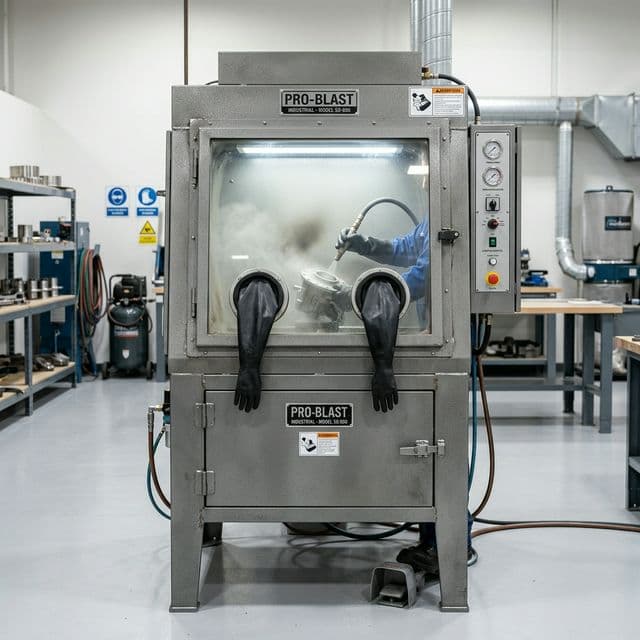
Sand Blasting Cabinet Machine
Designed for mid-to-large precision components. The PRO-400 series runs sand, garnet or aluminium oxide grit blasting media through a 5 or 6 mm tungsten carbide nozzle, with a laminated viewing window, cyclone reclaim and a cartridge dust collector on board.
TYPICAL SPECIFICATIONS.
Nozzle bore drives everything else. Pick the bore for your component and the compressor, pot size and dust collector follow from it. We size all four together before quoting a price.
| Parameter | Typical Range |
|---|---|
| Cabinet internal size (W x D x H) | 600 x 600 x 600 mm up to 1,800 x 1,200 x 1,200 mm |
| Pressure pot capacity | 20, 40, 60 or 100 litres, ASME pattern welded vessel |
| Working pressure | 2 to 7 bar (30 to 100 PSI), regulated at the pot |
| Nozzle bore | 4, 5, 6 or 8 mm long venturi, tungsten or boron carbide |
| Air consumption | 25 CFM at 4 mm / 7 bar, rising to about 250 CFM at 8 mm / 7 bar |
| Compressor requirement | 5 HP to 40 HP screw or reciprocating, with air dryer |
| Gun type | Suction (siphon) feed or pressure feed, remote foot pedal |
| Dust collector airflow | 500 to 2,000 CFM, cartridge or bag type with reverse pulse |
| Abrasive media | Aluminium oxide, garnet, glass bead, chilled iron grit, silica free grit |
| Viewing window | Laminated safety glass with replaceable sacrificial film |
| Media reclaim | Cyclone separator returning usable grit to the hopper |
Indicative ranges across the standard build. Exact specifications vary by configuration and are confirmed on the approved general arrangement drawing for your order.
WHY GRIT
BLASTING WORKS.
Protection
Grit blasting strips rust, mill scale and old paint back to clean steel before any coating goes on.
Adhesion
Angular grit cuts a 40 to 90 micron anchor profile that thermal spray and epoxy both key into.
Precision
Drop to 2 bar and switch to glass bead for thin sheet, alloy castings and finished machined faces.
Frequently Asked Questions.
Direct answers on compressor sizing, abrasive media selection and the regulatory position on silica sand in India.
What compressor size does a sand blasting machine need?
Compressor size follows the nozzle bore: roughly 5 to 7.5 HP for a 4 mm bore, 10 HP for 5 mm, 20 HP for 6 mm, 30 to 40 HP for 8 mm, 60 HP for 10 mm and 100 HP for a 12 mm bore, all at 7 bar. In airflow terms that is about 25 CFM at 4 mm rising to about 400 CFM at 12 mm. Always size the compressor with headroom and fit an aftercooler and air dryer, because moisture in the line causes the abrasive to clog and ruins the blast pattern. A nozzle worn one size up draws considerably more air for the same output, so gauge the bore regularly rather than uprating the compressor.
Is silica sand blasting legal in India?
India does not operate a single nationwide ban on abrasive blasting with silica sand, but the practice is heavily regulated and substitution with silica-free media is the accepted industry standard. Silicosis, caused by inhaling respirable crystalline silica, is a notifiable occupational disease under the Factories Act, 1948, and operations that generate silica dust carry dust-control, ventilation, health-surveillance and record-keeping duties on the factory occupier. Several state factory rules and many client specifications prohibit dry blasting with free-silica sand outright. For that reason most Indian workshops now specify garnet, aluminium oxide, chilled iron grit, steel grit or copper slag instead, and the current requirement should be confirmed with the state factory inspectorate for the site in question.
What abrasive media should be used before a thermal spray coating?
Thermal spray coatings need a sharp angular abrasive — aluminium oxide or chilled iron grit are the usual choices, with garnet acceptable on lighter work. Angular media cuts an anchor profile that the sprayed coating keys into mechanically, whereas rounded media such as steel shot or glass bead peens the surface smooth and leaves nothing for the coating to grip. The media must also be dry, oil-free and free of embedded fines, and for zinc or aluminium metallizing ISO 2063 asks for Sa 3 cleanliness with a 60 to 100 micron profile, sprayed before rust bloom appears.
What is the difference between pressure blasting and suction blasting?
A pressure feed machine holds the abrasive in a pressurised pot and pushes media and air down a single hose, while a suction (siphon) feed gun draws abrasive up from an unpressurised hopper using the venturi effect of the air stream. Pressure feed is several times faster and is what is specified for descaling, rust removal and profiling before coating. Suction feed is cheaper, gentler and better suited to light cleaning, etching and continuous cabinet work with fine media.
What working pressure should a sand blasting machine run at?
Sand blasting machines are normally regulated between 2 and 7 bar (30 to 100 PSI) at the nozzle. Steel descaling and profiling before coating runs at the top of that band, around 6 to 7 bar, because cleaning rate falls off sharply as pressure drops. Thin sheet, aluminium castings and finished machined faces are blasted at 2 to 3 bar, usually with glass bead or fine garnet, to clean the surface without distorting or eroding it.
Request a Quote.
Tell us the component, the media you plan to run and your compressor capacity. Our Pune engineers will come back with a cabinet size, a nozzle bore and a price.