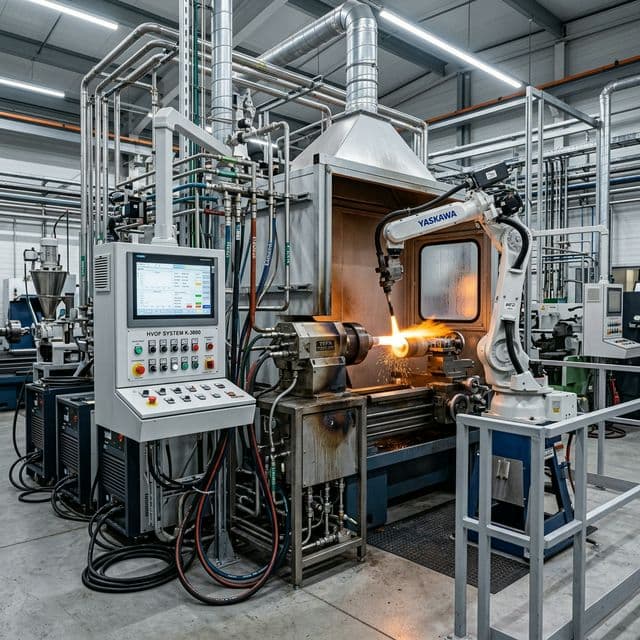
HVOF COATING PLANT
AND SPRAY SYSTEMS.
Metaflux Spray Solutions manufactures HVOF (high velocity oxy-fuel) coating plants in Pimpri-Chinchwad, Pune, India, for applying dense tungsten carbide and chrome carbide wear coatings to industrial components.
Supersonic Coating Plant
Kerosene and oxygen burn in a water-cooled chamber and expand through a converging-diverging barrel. Powder injected into that jet reaches supersonic speed and impacts the substrate below its melting point, which is why HVOF gives dense, low-oxide tungsten carbide (WC-Co) and chrome carbide coatings.
TYPICAL
SPECIFICATIONS.
Typical operating data for the liquid-fuel HVOF coating plant and its gas control console. Exact specifications vary by configuration — request a datasheet for the model you are evaluating.
| Parameter | Typical Range |
|---|---|
| Fuel Type | Liquid (Kerosene / ATF) or Gaseous (LPG, Propylene, Hydrogen) |
| Combustion Chamber Pressure | 6 – 10 bar |
| Oxygen Consumption | 800 – 1,000 SLPM (liquid fuel series) |
| Fuel Consumption | 20 – 30 l/hr kerosene equivalent |
| Powder Feed Rate | 50 – 120 g/min |
| Particle Velocity | 600 – 850 m/s (Mach 2+) |
| Bond Strength | Up to 10,000 psi (approx. 70 MPa) |
| Coating Porosity | Below 1.0% |
| Coating Hardness (WC-Co) | 1,000 – 1,300 HV |
| Powder Compatibility | WC-Co, WC-Co-Cr, Cr₃C₂-NiCr, Stellite, Inconel, MCrAlY |
| Typical Coating Thickness | 100 – 500 microns |
| Spray Distance | 300 – 380 mm |
| Barrel Lengths | 4 in / 6 in / 8 in |
| Gun Cooling Water | 25 – 40 l/min |
FREQUENTLY ASKED
QUESTIONS.
The questions coating shops and design engineers ask most often about HVOF coating plants and carbide coatings.
What does HVOF stand for, and how does the process work?
HVOF stands for high velocity oxy-fuel. Kerosene or a fuel gas burns with oxygen in a water-cooled combustion chamber at 6 to 10 bar and the exhaust expands through a converging-diverging barrel. Powder injected into that jet is accelerated to roughly 600 to 850 m/s and strikes the component below its melting point, which is what produces a dense, low-oxide coating.
Which coating materials can an HVOF system apply?
An HVOF coating plant applies tungsten carbide (WC-Co and WC-Co-Cr), chrome carbide (Cr₃C₂-NiCr), Stellite, Inconel and MCrAlY powders. Carbide grades are the most common because HVOF melts the metallic binder without decarburising the carbide. Metaflux Spray Solutions also supplies the matching powder feeder and gas control console so the same powder chemistry can be run repeatably.
Is HVOF used to replace hard chrome plating?
Yes — HVOF tungsten carbide coating is widely used as an alternative to hard chrome plating on hydraulic rods, piston rods, pump sleeves and valve components. It is a dry process with no hexavalent chromium bath, and typical HVOF WC-Co hardness of 1,000 to 1,300 HV is higher than hard chrome. Qualifying a coating against a customer's own specification remains the coating shop's responsibility.
What is the difference between HVOF and plasma spray?
HVOF is a high-velocity, comparatively low-temperature process and plasma spray is a low-velocity, very high-temperature process. HVOF therefore gives denser, better-bonded carbide and metallic coatings, while plasma spray reaches the 8,000 to 15,000 °C needed to melt ceramics such as zirconia and alumina. Coating shops that need both usually run an HVOF plant and a plasma cell side by side, and Metaflux Spray Solutions manufactures both.
What utilities does an HVOF coating plant need?
A liquid-fuel HVOF plant typically consumes 800 to 1,000 SLPM of oxygen, 20 to 30 l/hr of kerosene-equivalent fuel and 25 to 40 l/min of gun cooling water, plus compressed air and a three-phase supply for the console and feeder. Because HVOF is loud and dusty, the plant is normally installed with an acoustic booth, a manipulator or lathe, and dust extraction. Exact figures vary by gun and barrel configuration.
How much does an HVOF coating plant cost in India?
Metaflux Spray Solutions quotes HVOF coating plant prices on request, because the price depends on the gun and barrel set, the powder feeder, the gas control console and whether the booth, manipulator and extraction are included in the turnkey scope. Send the component type, coating material and production volume through the enquiry form on this page for a written quotation from Pune.
HVOF Coating Applications
Carbide Coatings for Wear Resistance.
Hard Chrome Replacement
WC-Co on hydraulic rods and piston rods, without hexavalent chrome plating.
Erosion Resistance
Pump sleeves, valve trim, fan blades and boiler tube shields.
Wear Surfaces
Rolls, plungers, ball valves and gate valve seats.