Zinc and Zinc-Aluminium Metallizing Coatings for Corrosion Protection
Zinc, aluminium and the Zn-Al 85/15 alloy are metallizing coating materials applied from wire by wire flame spray or twin wire arc spray to protect structural steel from corrosion sacrificially, typically 100–250 µm thick to ISO 2063 on bridges, transmission towers, penstocks, ships and offshore structures.
The coating applied by metallizing. Sprayed zinc, aluminium and the Zn-Al 85/15 alloy protect structural steel cathodically for decades — and unlike paint, they keep protecting at a scratch, a cut edge or a drilled hole because the coating corrodes in place of the steel.
The Material.
Thermally sprayed zinc and aluminium — universally called metallizing or metalizing in Indian workshops — is applied from wire by a wire flame spray gun or a twin wire arc spray gun. Zinc and Zn-Al are anodic to steel, so they provide sacrificial cathodic protection: where the coating is damaged, the surrounding zinc corrodes preferentially and the exposed steel does not rust. Aluminium works mainly as a barrier with partial cathodic action, and holds up better in immersion and at temperature.
The selection between them is environment-driven. Zinc is the general atmospheric choice. Aluminium (thermally sprayed aluminium, TSA) is specified for marine immersion, splash zone service and hot process vessels where it is used to prevent corrosion under insulation up to around 550 °C. The Zn-Al 85/15 alloy sits between the two and is the common general-purpose specification, combining zinc's galvanic activity with aluminium's barrier behaviour.
Almost everything about the result is decided by surface preparation, not by the gun. ISO 2063 requires blast cleaning to Sa 3 with a sharp angular anchor profile of roughly 60–100 µm, and spraying before any rust bloom forms — hours, not days. That is why the blasting equipment and the spray equipment need to be specified together.
Properties And Specification.
Typical values for a production thermal spray deposit. Confirm against coupons for your own substrate, geometry and duty cycle before releasing a drawing.
| Property | Typical Value |
|---|---|
| Materials | Pure zinc, pure aluminium, and the Zn-Al 85/15 alloy, supplied as 2.0, 2.5 or 3.17 mm wire |
| Hardness | Roughly 30–70 HV — this is a corrosion coating, not a wear coating |
| Protection mechanism | Sacrificial (cathodic) for zinc and Zn-Al; barrier with partial cathodic action for aluminium |
| Governing standard | ISO 2063 for the coating; ISO 12944 for the environment corrosivity category |
| Typical thickness | 100 µm zinc; 150–250 µm aluminium or Zn-Al in ISO 12944 C4 and C5 environments |
| Surface preparation | Sa 3 (SSPC-SP 5) blast clean, 60–100 µm angular anchor profile, sprayed before rust bloom |
| Sealing | Thin epoxy, vinyl or silicone sealer penetrates the porosity and extends life |
| Service life | Two decades and more to first maintenance is routinely achieved in marine service when applied and sealed to ISO 2063 |
| Maximum service temperature | Zinc to about 200 °C; sprayed aluminium to about 550 °C |
Which Spray Process Applies It.
Wire flame spray (metallizing)
Oxy-fuel melts the wire and compressed air atomises it onto the surface. Light, portable and the usual choice for site work on bridges, towers and tanks.
See the equipmentTwin wire arc spray
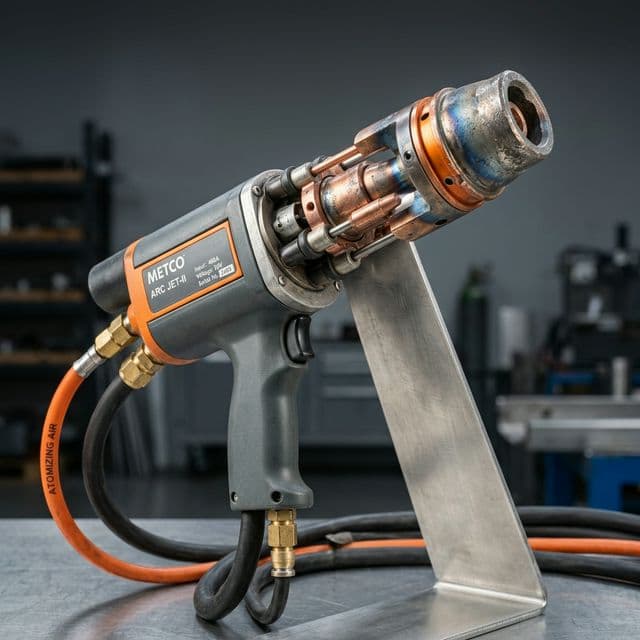
An arc struck between two converging wires, atomised by compressed air. Much higher deposition rate than flame spray, which is what makes large structural areas economic.
See the equipmentSurface preparation
Not optional. Sa 3 blast cleaning with a sharp angular profile is the single largest determinant of coating adhesion and service life.
See the equipmentTypical Applications.
- Highway and railway bridge steelwork
- Transmission towers and substation structures
- Penstocks, hydro gates and trash racks
- Offshore platforms, topsides and splash zones
- Ship decks, hulls and ballast tanks
- LPG and LNG storage vessels
- Wind tower flanges and internals
- Gantry cranes and coastal structural steel
Why Choose This Material.
It still protects where it is damaged
Paint fails at a scratch, a cut edge or a bolt hole because the barrier is broken and the steel is exposed. A sacrificial zinc coating corrodes preferentially and keeps the steel protected around the defect.
No cure time
The coating is solid the moment it lands. Structures can be handled, turned and moved immediately instead of tying up shop space through a paint cure cycle.
Applied on site with portable equipment
Metallizing is the standard repair and maintenance route for structures already in the field, because a wire flame spray gun and a compressor go where the structure is.
Life measured in decades
For a bridge or an offshore structure, the cost that matters is repainting access and downtime. A metallized system pushes first maintenance out by decades and changes the whole-life cost, not just the application cost.
Where It Is The Wrong Choice.
- Soft and low-hardness — it offers essentially no abrasion or wear resistance.
- Entirely dependent on blast profile and cleanliness; a poor Sa 2½ prep will show up as adhesion failure.
- Porous as sprayed, so a sealer is normally specified for immersion and aggressive service.
- Not suitable for strongly acidic or alkaline immersion, where zinc is attacked from both directions of the pH scale.
Specify The Equipment For This Coating.
We manufacture the spray guns, plants, powder feeders, flow meters and blasting equipment that deposit Zinc and Zinc-Aluminium — built in Pimpri-Chinchwad, Pune and supplied across India and the Middle East. Tell us the component and the duty and we will specify against it.
Frequently Asked Questions.
Direct answers on specifying Zinc and Zinc-Aluminium thermal spray coatings.
What surface preparation does a metallizing coating require?
ISO 2063 requires blast cleaning to Sa 3 with a sharp angular anchor profile of roughly 60 to 100 microns, with the zinc or aluminium sprayed before any rust bloom forms — hours, not days. Metallizing bonds mechanically, so surface preparation, not the spray gun, is the largest single determinant of adhesion and service life. Angular chilled iron grit or aluminium oxide cuts that profile; rounded steel shot peens the surface and does not.
What is the difference between sprayed zinc and sprayed aluminium?
Zinc protects steel sacrificially and is the general atmospheric choice, while thermally sprayed aluminium (TSA) works mainly as a barrier with partial cathodic action and is specified for marine immersion, splash zone service and hot process vessels. Zinc is limited to about 200 °C in service; sprayed aluminium holds to about 550 °C and is used to prevent corrosion under insulation. The Zn-Al 85/15 alloy sits between the two and is the common general-purpose specification.
How long does a metallizing coating last?
Two decades and more to first maintenance is routinely achieved in marine service when the coating is applied and sealed to ISO 2063. The reason is that a sacrificial coating keeps protecting where it is damaged: at a scratch, a cut edge or a drilled hole the surrounding zinc corrodes preferentially and the exposed steel does not rust, whereas paint fails at exactly those points. Actual life depends on the ISO 12944 corrosivity category, the coating thickness and whether a sealer was applied.
Can metallizing be applied on site?
Yes — metallizing is the standard repair and maintenance route for structures already in the field, because a wire flame spray gun, a portable blast pot and a compressor go where the structure is. Wire flame spray is light and portable and is the usual choice for site work on bridges, towers and tanks; twin wire arc spray gives a much higher deposition rate and is what makes large structural areas economic. Metaflux Spray Solutions manufactures both, along with the blasting equipment the preparation requires.