Stellite 6 Cobalt Alloy Coatings (Co-Cr-W)
Stellite 6 is a cobalt-chromium-tungsten hardfacing alloy applied by powder flame spray, HVOF, arc spray or spray-and-fuse to resist galling, cavitation and impact, typically about 40–46 HRC (400–450 HV) when sprayed and fused and useful to roughly 500–600 °C on valve seats, pump sleeves and turbine erosion shields.
A cobalt-chromium-tungsten hardfacing alloy for the wear that carbides handle badly: metal-to-metal galling, cavitation, impact and thermal cycling. Softer than a cermet, far tougher, and it machines and grinds conventionally.
The Material.
Stellite 6 is the best known of the Co-Cr-W-C hardfacing alloys — roughly 28–32% chromium, 4–6% tungsten and around 1% carbon in a cobalt matrix. The chromium and tungsten form carbides within a cobalt solid solution that work-hardens under load, and it is that combination which gives the alloy its characteristic behaviour: it resists galling and cavitation far better than its hardness number suggests.
This matters because hardness is the wrong metric for the failures Stellite 6 is chosen for. A valve seat does not fail by being abraded; it fails by galling against its mating face, by cavitation pitting, or by impact on closing. A 1,300 HV carbide coating is harder but brittle, and it chips. A 45 HRC cobalt alloy deforms, work-hardens and survives.
It also holds up hot. Useful hardness is retained to roughly 500–600 °C and the chromium content gives oxidation and corrosion resistance in oxidising media, which is why it appears on steam valves, exhaust valve faces and glass mould tooling. Stellite is a registered trade mark; the same composition is supplied by several producers under their own alloy designations.
Properties And Specification.
Typical values for a production thermal spray deposit. Confirm against coupons for your own substrate, geometry and duty cycle before releasing a drawing.
| Property | Typical Value |
|---|---|
| Nominal composition | Cobalt balance, 27–32% Cr, 4–6% W, 0.9–1.4% C, with minor Fe, Ni and Si |
| Hardness | Roughly 40–46 HRC (about 400–450 HV) sprayed and fused; lower as-sprayed without a fusing step |
| Hot hardness | Useful hardness retained to roughly 500–600 °C |
| Key wear resistance | Galling, adhesive wear, cavitation erosion and impact; work-hardens in service |
| Corrosion resistance | Good in oxidising media from the high chromium content |
| Typical coating thickness | 250 µm to several millimetres depending on the process |
| Supply form | Powder for flame, HVOF and plasma spray; wire for arc and flame spray |
| Machining | Conventional grinding; carbide tooling for light cuts |
Which Spray Process Applies It.
Powder flame spray and spray-fuse
The traditional route for cobalt hardfacing alloys. Spraying followed by a fusing pass produces a metallurgically bonded, fully dense deposit — the highest integrity option where the component can take the heat.
See the equipmentWire flame spray and arc spray
Where the alloy is available as wire, both give high deposition rates for rebuilding worn shafts and sleeves before final grinding.
See the equipmentHVOF
Dense, low-oxide as-sprayed deposit with no fusing heat into the component. Preferred where distortion or metallurgical change in the substrate is unacceptable.
See the equipmentTypical Applications.
- Valve seats, gates, discs and wedges
- Pump sleeves, wear rings and shaft journals
- Steam turbine blade erosion shields
- Hot shear blades and trim tooling
- Glass mould plungers and neck rings
- Engine exhaust valve faces
- Chemical and food processing pump parts
- Screw conveyor flights in hot service
Why Choose This Material.
Galling and cavitation, not abrasion
When two metal faces are sliding, seating or cavitating against each other, toughness beats hardness. Carbide coatings chip in that duty; Stellite 6 work-hardens and holds.
Tolerates impact and thermal cycling
The cobalt matrix is ductile enough to absorb impact and to survive repeated heating and cooling without spalling — conditions that crack a brittle cermet.
Rebuilds as well as protects
Thick deposits are practical, so a worn shaft journal or valve seat can be built back to size and ground, rather than scrapped.
Where It Is The Wrong Choice.
- At roughly 450 HV it is far softer than a carbide — the wrong choice for hard particle abrasion.
- Cobalt is expensive and price-volatile relative to nickel and iron based hardfacing alloys.
- Cobalt content is restricted in some nuclear service because of activation, where nickel-based alternatives are specified instead.
- Spray-and-fuse puts significant heat into the component, which limits it on thin sections and distortion-sensitive parts.
Specify The Equipment For This Coating.
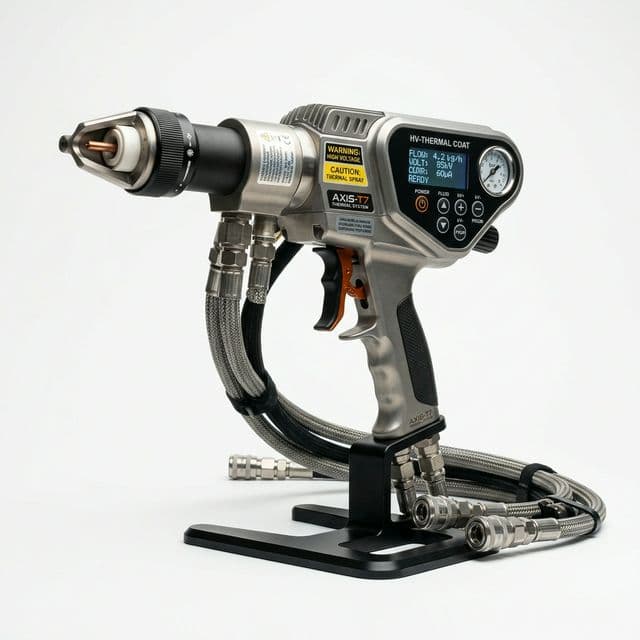
We manufacture the spray guns, plants, powder feeders, flow meters and blasting equipment that deposit Stellite 6 (Co-Cr-W) — built in Pimpri-Chinchwad, Pune and supplied across India and the Middle East. Tell us the component and the duty and we will specify against it.
Frequently Asked Questions.
Direct answers on specifying Stellite 6 (Co-Cr-W) thermal spray coatings.
What is Stellite 6 used for?
Stellite 6 is used where metal faces slide, seat or cavitate against each other rather than where hard particles abrade the surface: valve seats, gates, discs and wedges, pump sleeves, wear rings and shaft journals, steam turbine blade erosion shields, hot shear blades, glass mould plungers and engine exhaust valve faces. It is also used to rebuild worn shaft journals and seats back to size before grinding, because thick deposits are practical with this alloy.
How hard is Stellite 6?
Roughly 40 to 46 HRC, about 400 to 450 HV, when sprayed and fused; as-sprayed deposits without a fusing step are softer. That is far below a carbide cermet, and deliberately so. Stellite 6 works by a cobalt matrix that work-hardens under load rather than by initial hardness, which is why it resists galling and cavitation better than its hardness number suggests. Useful hardness is retained to roughly 500–600 °C.
Why choose Stellite 6 instead of tungsten carbide?
Because the failure mode is toughness-limited rather than hardness-limited. A 1,300 HV tungsten carbide coating is harder but brittle, and it chips under impact, thermal cycling and repeated valve seating. A cobalt alloy at about 450 HV deforms, work-hardens and survives that duty. Choose tungsten carbide for hard-particle abrasion and Stellite 6 for galling, cavitation and impact.
Is Stellite 6 a trade mark?
Stellite is a registered trade mark, and the Co-Cr-W-C composition described here — nominally cobalt balance with 27–32% chromium, 4–6% tungsten and 0.9–1.4% carbon — is supplied by several producers under their own alloy designations. Specify the composition and hardness required rather than the trade name alone when sourcing powder or wire.