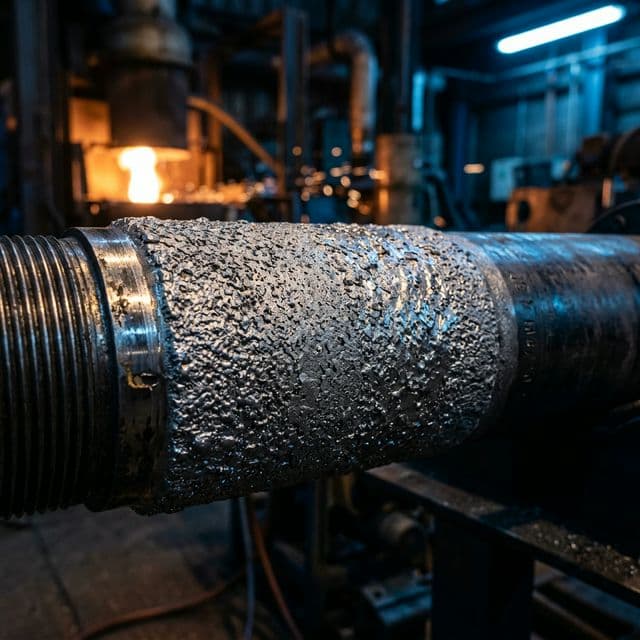
Tungsten Carbide (WC-Co) Thermal Spray Coatings
Tungsten carbide (WC-Co) is a thermal spray coating material applied by HVOF to protect components against abrasive, sliding and erosive wear, typically reaching 1,100–1,350 HV0.3 in production and used up to about 500 °C on hydraulic cylinder rods, pump plungers, valve trim and extruder screws.
The hardest coating in routine thermal spray production and the standard answer to abrasive, sliding and erosive wear on metallic components below about 500 °C. It is also the coating that replaced hard chrome plating on hydraulic rods and landing gear.
The Material.
Tungsten carbide coatings are cermets: hard tungsten carbide grains held in a ductile metallic binder. The binder is what makes the coating survivable — pure WC would be too brittle to stay on a loaded surface — and its chemistry is how the grade is chosen. WC-12Co and WC-17Co are the general-purpose wear grades; WC-10Co-4Cr adds chromium to the binder and is the grade specified where corrosion accompanies wear, which is most hydraulic and pump service.
The performance comes from the combination of grain hardness and coating density. A well-sprayed WC-CoCr deposit runs below 1% porosity with no through-thickness cracks, so there is no path for a corrodent to reach the steel underneath. High-velocity impact also leaves the coating in compression, which is why WC-Co coatings carry far less fatigue penalty than the microcracked, tensile-stressed hard chrome deposit they usually replace.
The critical process constraint is decarburisation. Held too long at too high a temperature, WC decomposes into W₂C and brittle eta phase, and the coating's abrasive wear life drops sharply. That is a chemistry problem, not a workmanship problem, and it is the reason tungsten carbide is sprayed on an HVOF gun rather than a plasma torch.
Properties And Specification.
Typical values for a production thermal spray deposit. Confirm against coupons for your own substrate, geometry and duty cycle before releasing a drawing.
| Property | Typical Value |
|---|---|
| Common grades | WC-12Co, WC-17Co, WC-10Co-4Cr (the corrosion-plus-wear grade) |
| Coating hardness | 1,100–1,350 HV0.3 as sprayed by HVOF |
| Bond strength (ASTM C633) | 70–100 MPa (10,000–14,500 psi) |
| Porosity | Below 1% |
| Residual stress | Compressive |
| Maximum service temperature | About 500 °C. Above this WC oxidises and hardness falls — specify chrome carbide instead |
| Typical coating thickness | 100–500 µm |
| Surface finish | Ra 3–5 µm as sprayed; diamond ground and superfinished below Ra 0.2 µm |
| Machining | Diamond grinding only — too hard for conventional abrasives |
Which Spray Process Applies It.
HVOF
The production standard. Supersonic particle velocity with a moderate flame temperature deposits dense WC-Co with minimal decarburisation. Everything written above assumes an HVOF deposit.
See the equipmentHVAF
A lower-temperature, higher-velocity variant. Even less carbide degradation, at the cost of a narrower material window.
Plasma spray
Not recommended for tungsten carbide. The plasma core decarburises WC into W₂C and eta phase, measurably reducing wear life. Plasma is the right torch for oxide ceramics, not carbides.
Typical Applications.
- Hydraulic cylinder rods and piston rods
- Pump plungers, sleeves and shafts
- Ball, gate and choke valve trim
- Extruder screws and barrel liners
- Wire drawing capstans and guide rolls
- Paper and printing roll journals
- Fan and mixer blades in abrasive duty
- Hard chrome plating replacement
Why Choose This Material.
Highest abrasion resistance below 500 °C
Nothing else in the thermal spray family matches WC-Co for three-body abrasion and sliding wear at ambient to moderate temperature. If the failure mode is material being scraped away, this is the coating.
Density that keeps corrodents out
Sub-1% porosity with no through-thickness cracking means the substrate is genuinely shielded, unlike a microcracked plated deposit where the corrodent reaches the steel and undermines the coating from beneath.
Compressive stress helps fatigue
The peening action of semi-molten particles arriving at 700 m/s leaves the deposit in compression. On rotating and reciprocating parts this is the difference between a coating that costs fatigue life and one that does not.
Where It Is The Wrong Choice.
- Loses hardness above roughly 500 °C as the carbide oxidises — use chrome carbide for hot service.
- Line-of-sight process: deep or small bores are difficult to coat and may not be candidates at all.
- Requires diamond grinding and superfinishing, so the finishing route has to exist before the coating is specified.
- Hard but not tough — heavy impact loading favours a cobalt alloy such as Stellite 6 instead.
Specify The Equipment For This Coating.
We manufacture the spray guns, plants, powder feeders, flow meters and blasting equipment that deposit Tungsten Carbide (WC-Co) — built in Pimpri-Chinchwad, Pune and supplied across India and the Middle East. Tell us the component and the duty and we will specify against it.
Frequently Asked Questions.
Direct answers on specifying Tungsten Carbide (WC-Co) thermal spray coatings.
How hard is an HVOF tungsten carbide coating?
A production HVOF tungsten carbide coating typically measures 1,100 to 1,350 HV0.3, making it the hardest coating in routine thermal spray use. The exact figure depends on the grade — WC-12Co, WC-17Co or WC-10Co-4Cr — on powder chemistry and particle size, and on spray parameters. Treat that band as a typical range for shortlisting a specification, and confirm it on coupons sprayed with your own substrate and parameters before releasing a drawing.
What is the maximum service temperature of a tungsten carbide coating?
About 500 °C. Above roughly that temperature the tungsten carbide oxidises and the coating loses hardness and wear resistance, so tungsten carbide is the wrong specification for hot service. Chrome carbide (Cr₃C₂-NiCr) takes over above it and works to roughly 900 °C, which is why the choice between the two carbides is almost always a service-temperature decision rather than a hardness decision.
Which components are coated with tungsten carbide?
Hydraulic cylinder rods and piston rods, pump plungers, sleeves and shafts, ball, gate and choke valve trim, and extruder screws and barrel liners are the most common. Wire drawing capstans, paper and printing roll journals, and fan and mixer blades in abrasive duty are also routine. In most of these cases the coating is replacing electrolytic hard chrome plating.
Why is tungsten carbide sprayed by HVOF rather than plasma spray?
Because the plasma core decarburises tungsten carbide into W₂C and brittle eta phase, which measurably shortens the coating's abrasive wear life. HVOF holds the powder at a much lower flame temperature — roughly 2,600 to 3,000 °C against 8,000 to 15,000 °C in a plasma — for a much shorter dwell time, so the carbide survives the flight to the component. That is a chemistry constraint, not a workmanship one, and it cannot be tuned out with spray parameters.