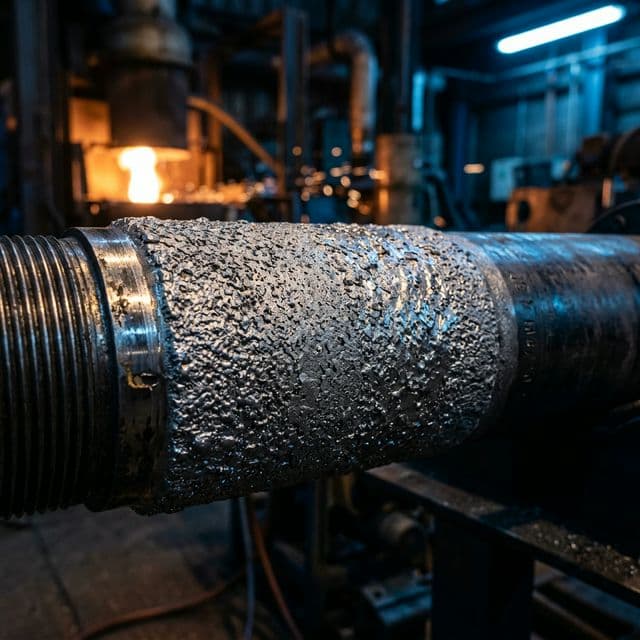
HVOF Coating as a Hard Chrome Replacement
HVOF-sprayed tungsten carbide (WC-10Co-4Cr) replaces electrolytic hard chrome plating on hydraulic rods, pump plungers, valve parts and landing gear, giving roughly 1,100–1,300 HV0.3 against hard chrome's 800–1,000 HV with no hexavalent chromium and no plating effluent.
Electrolytic hard chrome plating is under regulatory pressure everywhere because its electrolyte is hexavalent chromium. HVOF-sprayed tungsten carbide is the substitution that engineering, rather than compliance, would have chosen anyway — harder, denser, compressively stressed, and applied in minutes instead of hours.
Three Reasons, And Only One Of Them Is Regulation.
Hexavalent Chromium Is Being Regulated Out
Chromium trioxide, the electrolyte for hard chrome plating, is a category 1B carcinogen and sits on the REACH Authorisation List — it can only be used under a granted authorisation with a defined review period. RoHS restricts Cr(VI) in electrical and electronic equipment. Occupational exposure limits for Cr(VI) have been tightened repeatedly. None of this bans plating tomorrow, but it steadily raises the compliance cost of running a chrome shop and makes long-term supply of chrome-plated parts a procurement risk.
The Coating Genuinely Performs Better
This substitution is not a compliance compromise. A WC-CoCr HVOF coating is harder, denser and compressively stressed. The aerospace qualification programmes that drove the original replacement work on landing gear found HVOF WC-Co/Cr matched or exceeded hard chrome on wear, corrosion and — critically — fatigue, because chrome's microcrack network and tensile stress are what hurt fatigue life in the first place.
The Effluent Problem Disappears
A plating line generates rinse water and spent bath containing hexavalent chromium, which is a listed hazardous waste with treatment, storage and disposal obligations. HVOF generates dry overspray captured on booth filters. For a plant already carrying an effluent treatment burden, removing the chrome line can be worth more than the coating performance.
Hard Chrome vs HVOF WC-CoCr.
Typical production values. Confirm on coupons against your own duty cycle before changing a drawing.
| Parameter | Hard Chrome Plating | HVOF WC-CoCr |
|---|---|---|
| Deposit | Electrolytic hard chrome, effectively pure chromium plated from a chromium trioxide bath. | WC-10Co-4Cr or WC-12Co cermet — tungsten carbide particles in a metallic binder. |
| Hardness | 800–1,000 HV, falling off above about 400 °C as the deposit tempers. | 1,100–1,300 HV0.3, stable to roughly 500 °C. |
| Structure | Microcracked by design — a dense network of through-thickness cracks relieves the tensile deposition stress. | Dense lamellar cermet, porosity typically below 1%, with no through-thickness crack network. |
| Residual stress | Tensile. Combined with the crack network, this debits the fatigue strength of the base metal. | Compressive, from high-velocity particle peening. Fatigue debit is far smaller. |
| Abrasive wear | Baseline. | Typically 2–5 times longer life in sliding and abrasive service; ASTM G65 volume loss is commonly several times lower. |
| Corrosion behaviour | Corrodents reach the substrate through the cracks; the steel underneath corrodes and undermines the plating. | No through-cracks. WC-CoCr with the chromium addition, and sealing where specified, resists salt spray far longer. |
| Hydrogen embrittlement | A real risk on high-strength steels; a post-plate bake to ASTM B850 or AMS 2759 is normally mandatory. | None. There is no electrolyte and no cathodic hydrogen. |
| Typical thickness | 25–500 µm, and readily built thicker. | 100–300 µm is normal; heavier builds are possible but rarely necessary. |
| Internal diameters | Can be plated inside long, small bores with conforming anodes. | Line-of-sight process. Practical below roughly 100 mm bore diameter only with a purpose-built ID gun, and depth is limited. |
| Deposition rate | Roughly 25 µm per hour — a 250 µm build is a ten-hour tank cycle. | Minutes per component, not hours. |
| Finishing | Ground and polished. Ra 0.1–0.2 µm routine. | As-sprayed Ra 3–5 µm; diamond grinding and superfinishing take it below Ra 0.2 µm, and below Ra 0.05 µm for hydraulic rod sealing surfaces. |
| Regulatory position | Chromium trioxide is a REACH Annex XIV substance requiring authorisation, a category 1B carcinogen, and restricted in electrical equipment under RoHS. Effluent is a listed hazardous waste stream. | No hexavalent chromium. Overspray is captured dry in the booth filtration system; no plating effluent is generated. |
How A Chrome-Plated Part Gets Converted.
- 01
Strip and inspect
Existing chrome is removed and the substrate is checked for cracks, undercut and dimensional loss before anything is deposited.
- 02
Grit blast to profile
Angular alumina or chilled iron grit to Sa 3, producing a clean anchor profile — coating adhesion is decided here, not at the gun.
- 03
HVOF spray
WC-10Co-4Cr or WC-12Co applied to a nominal 150–250 µm with the substrate held below 150 °C, usually on a lathe or a robot with controlled traverse.
- 04
Diamond grind and superfinish
The coating is too hard for conventional abrasive wheels. Diamond grinding to size, then superfinishing or lapping to the sealing surface requirement.
- 05
Verify
Bond strength to ASTM C633, microhardness to ASTM E384, metallographic porosity, and salt spray to ASTM B117 where corrosion is the driver.
Steps 02 and 03 are the equipment decision. Surface preparation needs a blast cabinet or blast room capable of holding a consistent profile, and the spray step needs an HVOF plant with a stable powder feeder and calibrated gas flow metering — an inconsistent powder feed rate is the single most common cause of a coating that fails bond testing.
Typical Components.
- Hydraulic cylinder rods and piston rods
- Pump plungers and pump shafts
- Landing gear pistons and axles
- Gate, ball and choke valve components
- Extruder screws and barrel liners
- Paper and printing roll journals
- Shaft sealing and bearing surfaces
- Mould tooling and wear plates
When Chrome Still Wins.
- Deep or small-diameter bores that a spray gun cannot reach on line of sight.
- Very heavy builds where 500 µm or more of deposit is needed on a simple geometry.
- Parts locked to an existing customer or airworthiness specification that names chrome plating.
- High-volume, low-value parts where the tank cycle cost per part is already trivial.
HVOF is a line-of-sight process. If the wear surface is inside a long bore, it is not a candidate, and no amount of regulatory pressure changes that. Check the geometry before the business case.
Frequently Asked Questions.
Direct answers on substituting HVOF tungsten carbide for electrolytic hard chrome plating.
Can HVOF coating replace hard chrome plating?
Yes, on external, line-of-sight wear surfaces HVOF-sprayed tungsten carbide replaces electrolytic hard chrome directly, and this substitution is established on hydraulic cylinder rods, pump plungers, valve components and aircraft landing gear. The replacement coating is normally WC-10Co-4Cr or WC-12Co applied to 150 to 250 microns, then diamond ground and superfinished to the original drawing size and surface finish. It is not a substitute where the wear surface is inside a deep or small-diameter bore, because HVOF is a line-of-sight process.
Why are plants moving away from hard chrome plating?
The electrolyte for hard chrome plating is chromium trioxide, a category 1B carcinogen that sits on the REACH Authorisation List and can only be used under a granted authorisation with a defined review period. Occupational exposure limits for hexavalent chromium have been tightened repeatedly and the plating line generates hazardous effluent requiring treatment and disposal. None of that bans plating outright, but it steadily raises the compliance cost of running a chrome shop and makes long-term supply of chrome-plated parts a procurement risk.
Is an HVOF tungsten carbide coating harder than hard chrome?
Yes. A WC-CoCr HVOF coating measures roughly 1,100 to 1,300 HV0.3 and holds that hardness to about 500 °C, against 800 to 1,000 HV for electrolytic hard chrome, which begins to temper and soften above about 400 °C. Hardness is not the whole story: the HVOF deposit is also denser, below 1% porosity with no through-thickness crack network, and it is left in compressive residual stress by high-velocity particle impact rather than the tensile stress of a plated deposit.
Does HVOF coating affect fatigue life the way hard chrome does?
The fatigue debit from HVOF is far smaller than from hard chrome. Hard chrome is microcracked by design — a dense network of through-thickness cracks relieves its tensile deposition stress — and that combination of cracks and tensile stress is what debits the fatigue strength of the base metal. An HVOF coating carries compressive residual stress from particle peening and has no crack network, which is precisely why aerospace qualification programmes on landing gear found it acceptable where plating was not.
Where does hard chrome plating still win?
Hard chrome remains the better answer for deep or small-diameter bores that a spray gun cannot reach on line of sight, for very heavy builds of 500 microns or more on simple geometry, for parts locked to an existing customer or airworthiness specification that names chrome plating, and for high-volume low-value parts where the tank cycle cost per part is already trivial. Geometry should be checked before the business case, because no amount of regulatory pressure makes a blind bore sprayable.
How is an HVOF coating finished to size?
By diamond grinding, followed by superfinishing or lapping where a sealing surface is required. The coating is too hard for conventional abrasive wheels. As-sprayed roughness is Ra 3 to 5 microns; diamond grinding takes it below Ra 0.2 microns, and hydraulic rod sealing surfaces are superfinished below Ra 0.05 microns. The finishing route has to exist in the shop before the coating is specified, because an unfinished HVOF deposit will destroy a rod seal.
Bring The Coating In-House.
We manufacture the HVOF coating plants, powder feeders, gas flow meters and blasting equipment this process route needs, and supply them as a complete cell with commissioning and operator training. Send us the component drawing and the current chrome specification.