HVOF vs Plasma Spray: Which Coating Process Should You Choose?
HVOF produces denser, higher-bond-strength carbide coatings for wear on metallic components, while plasma spray reaches far higher temperatures and is the process for oxide ceramic coatings such as yttria-stabilised zirconia, alumina and chromia.
HVOF is a velocity process and plasma spray is a temperature process. That single difference decides which materials each one can deposit, what bond strength and porosity result, and which one belongs on a given component.
Velocity Versus Temperature.
Both processes heat a powder and throw it at a substrate, where it flattens, solidifies and interlocks mechanically. What differs is the ratio of heat to speed. HVOF burns fuel with oxygen in a confined chamber and expands the gas through a converging-diverging nozzle, producing a supersonic jet at a relatively modest temperature. Plasma spray strikes an electric arc through an inert gas, producing a much hotter but much slower jet.
High speed and moderate heat gives you a dense, compressively stressed, low-oxide coating from materials that do not need extreme temperatures to melt. High heat and moderate speed lets you melt materials that nothing else in the thermal spray family can melt — at the cost of higher porosity, lower bond strength and tensile residual stress.
HVOF — High Velocity Oxy-Fuel
Fuel and oxygen burn continuously at 6–10 bar chamber pressure. The exhaust accelerates past Mach 2. Powder injected into that stream is only partly melted when it hits the part — and that is the point. Semi-molten particles arriving at 700 m/s peen the deposit, closing porosity and leaving compressive residual stress behind.
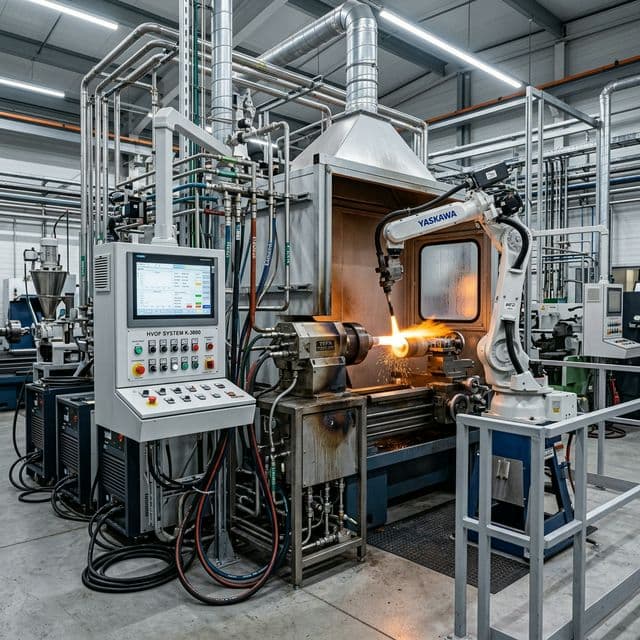
HVOF coating plantsPlasma Spray — Atmospheric (APS)
A DC arc ionises argon into a plasma at up to 15,000 °C. Powder injected into the jet melts completely, even ceramics with melting points above 2,000 °C. The splats solidify and shrink, which leaves tensile stress and a more porous lamellar structure — often a feature rather than a fault, since porosity is what makes a thermal barrier insulate.
Plasma spray equipmentHVOF vs Plasma Spray Comparison Table.
Typical values for production equipment. Actual figures depend on powder chemistry, particle size distribution, gun design and spray parameters, and should be confirmed on coupons before a specification is frozen.
| Parameter | HVOF | Plasma Spray (APS) |
|---|---|---|
| Heat source | Continuous combustion of kerosene, hydrogen, propane or propylene with oxygen inside a pressurised chamber. | A DC electric arc ionising argon, usually with hydrogen, helium or nitrogen as a secondary gas. |
| Jet temperature | Roughly 2,600–3,000 °C. | Roughly 8,000–15,000 °C in the plasma core. |
| Particle velocity | 500–800 m/s — Mach 2 and above. Velocity does the work. | 150–450 m/s for atmospheric plasma spray. Temperature does the work. |
| Bond strength (ASTM C633) | 70–100 MPa (10,000–14,500 psi) typical for WC-Co. | 20–40 MPa for oxide ceramics; up to about 70 MPa for metallics. |
| Porosity | Typically below 1%. | 1–7% for atmospheric plasma spray, and deliberately 10–20% for thermal barrier topcoats where compliance matters more than density. |
| Oxide content | 1–2%. Short dwell time at moderate temperature limits in-flight oxidation. | 2–5% when spraying metals in air; higher for reactive alloys. |
| Typical coating hardness | WC-10Co-4Cr around 1,100–1,300 HV0.3. | Cr₂O₃ around 1,300–1,800 HV; Al₂O₃ around 900–1,200 HV. |
| Materials it sprays best | WC-Co, WC-CoCr, Cr₃C₂-NiCr, MCrAlY, Inconel, stainless steels, Stellite and other cermets and alloys. | Al₂O₃, Al₂O₃-TiO₂, Cr₂O₃, yttria-stabilised zirconia, hydroxyapatite, molybdenum, MCrAlY. |
| Materials it handles badly | High-melting oxide ceramics. Zirconia melts near 2,700 °C and alumina at 2,072 °C — the flame cannot fully melt them in the dwell time available, so the coating comes out under-melted and weak. | Tungsten carbide. The plasma core decarburises WC into W₂C and brittle eta phase, which measurably shortens abrasive wear life. |
| Substrate temperature | Normally held below 150 °C with auxiliary air or CO₂ cooling. | Higher radiant heat input; below 200 °C is achievable but needs more aggressive cooling and traverse control. |
| Residual stress in the coating | Compressive, because high-velocity semi-molten particles peen the deposit as they impact. Helps fatigue performance. | Tensile, from solidification shrinkage of fully molten splats. |
| Practical thickness range | 50–500 µm. Compressive stress allows thicker carbide builds without spalling. | 100 µm up to several millimetres for thermal barrier systems. |
| Deposition efficiency | Roughly 45–70%, material dependent. | Roughly 40–70%, material dependent. |
| As-sprayed surface finish | Ra 3–5 µm; diamond ground and superfinished to below Ra 0.2 µm for sealing surfaces. | Ra 5–8 µm for ceramics; diamond grinding is effectively mandatory. |
| Main running cost | Fuel and oxygen consumption, plus powder. | Argon and hydrogen, plus 40–80 kW of electrical power and electrode/nozzle wear. |
| Best suited to | Wear, erosion and corrosion on metallic components — and replacing hard chrome plating. | Ceramic functions — thermal barriers, electrical insulation, dielectric rolls, biomedical implants. |
When To Choose Which.
Choose HVOF When
- The coating material is a carbide cermet — WC-Co, WC-CoCr or Cr₃C₂-NiCr.
- The failure mode is abrasive, sliding or erosive wear on a metallic component.
- The part is fatigue-loaded and cannot tolerate a tensile-stressed, cracked coating.
- You are replacing electrolytic hard chrome and need a comparable or better ground finish.
- Coating density matters because a corrodent must not reach the substrate through the coating.
Choose Plasma Spray When
- The coating material is an oxide ceramic — alumina, chromia, titania or zirconia.
- The function is thermal insulation, such as a yttria-stabilised zirconia thermal barrier.
- The coating must be electrically insulating, as on anilox and corona treater rolls.
- The material's melting point is above roughly 2,000 °C, which rules HVOF out on physics.
- The application is biomedical, such as hydroxyapatite on an implant surface.
Coatings Either Process Can Apply.
MCrAlY bond coats
Both processes deposit them. HVOF gives a denser, lower-oxide bond coat with better oxidation life; plasma is faster and cheaper when the topcoat is a thick TBC anyway.
Chrome carbide, Cr₃C₂-NiCr
Sprayable by either. HVOF produces the denser coating; plasma is used where an existing plasma cell is already installed and the service condition is high-temperature erosion rather than sliding wear.
Molybdenum and stainless steels
Either process works. The decision usually comes down to what equipment is already on the shop floor and the throughput required.
What About Cost?
Comparing cost per gun-hour is misleading. Plasma spray consumes argon and 40–80 kW of power; HVOF consumes fuel gas or kerosene and a lot of oxygen. Both are expensive to run. The number that matters is cost per coated component in service, and that is dominated by two things: deposition efficiency on the material you are actually spraying, and how many times the coating has to be re-applied before the part is scrapped.
A WC-CoCr coating sprayed by HVOF that runs three times longer than the plasma-sprayed equivalent — because the plasma decarburised the carbide — is cheaper even at a higher hourly rate. Conversely, spraying zirconia on an HVOF gun is not expensive, it is simply not possible to do well.
Frequently Asked Questions.
Direct answers to the process selection questions engineers ask when choosing between HVOF and plasma spray.
Is HVOF better than plasma spray?
Neither process is better in general — they deposit different material families. HVOF is the better process for carbide cermets and metallic alloys where the requirement is wear, erosion or corrosion resistance on a metal component, because it produces sub-1% porosity, 70 to 100 MPa bond strength and compressive residual stress. Plasma spray is the better process for oxide ceramics such as zirconia, alumina and chromia, because they melt above 2,000 °C and an oxy-fuel flame at 2,600 to 3,000 °C cannot melt them properly in the dwell time available.
Why is tungsten carbide not sprayed by plasma spray?
The plasma core reaches 8,000 to 15,000 °C, which decarburises tungsten carbide into W₂C and brittle eta phase and measurably shortens the coating's abrasive wear life. That is a chemistry problem rather than a workmanship problem, so it cannot be tuned out with parameters. HVOF holds the particle at a much lower flame temperature for a much shorter dwell time, which is why it is the production standard for WC-Co and WC-CoCr.
Which process gives higher bond strength?
HVOF gives higher bond strength: typically 70 to 100 MPa (10,000 to 14,500 psi) to ASTM C633 for WC-Co, against 20 to 40 MPa for oxide ceramics sprayed by atmospheric plasma and up to about 70 MPa for plasma-sprayed metallics. The difference comes from particle velocity — 500 to 800 m/s for HVOF against 150 to 450 m/s for atmospheric plasma spray — because higher-velocity impact flattens the particle harder onto the anchor profile and peens the deposit closed.
Can an HVOF gun spray alumina or zirconia?
Not well. Alumina melts at about 2,072 °C and yttria-stabilised zirconia near 2,700 °C, while an HVOF flame runs at roughly 2,600 to 3,000 °C, so the powder leaves the gun under-melted and the resulting coating is weak and poorly bonded. Ceramic coatings of this kind belong on a plasma torch, where the plasma core melts them completely. The reverse also applies: plasma is the wrong torch for tungsten carbide.
Which process is cheaper to run?
Cost per gun-hour is the wrong comparison, because both are expensive to run — plasma spray consumes argon plus 40 to 80 kW of electrical power and electrode wear, and HVOF consumes fuel gas or kerosene plus a large volume of oxygen. The number that decides the economics is cost per coated component in service, which is driven by deposition efficiency on the actual material and by how often the coating has to be re-applied before the part is scrapped.
Which coatings can either process apply?
MCrAlY bond coats, chrome carbide (Cr₃C₂-NiCr), molybdenum and stainless steels can all be applied by either HVOF or plasma spray. HVOF produces the denser, lower-oxide deposit in every case; plasma is chosen where a plasma cell is already installed, where throughput matters more than density, or where the topcoat above a bond coat is a thick thermal barrier anyway. Metaflux Spray Solutions manufactures both HVOF coating plants and plasma spray systems in Pune.
Specify The Equipment Against Your Component.
We manufacture HVOF coating plants, plasma spray systems, powder feeders and gas flow meters at our Pune works, and integrate them into complete coating cells. Tell us the component, the substrate, the coating material and the throughput, and we will come back with a specification.